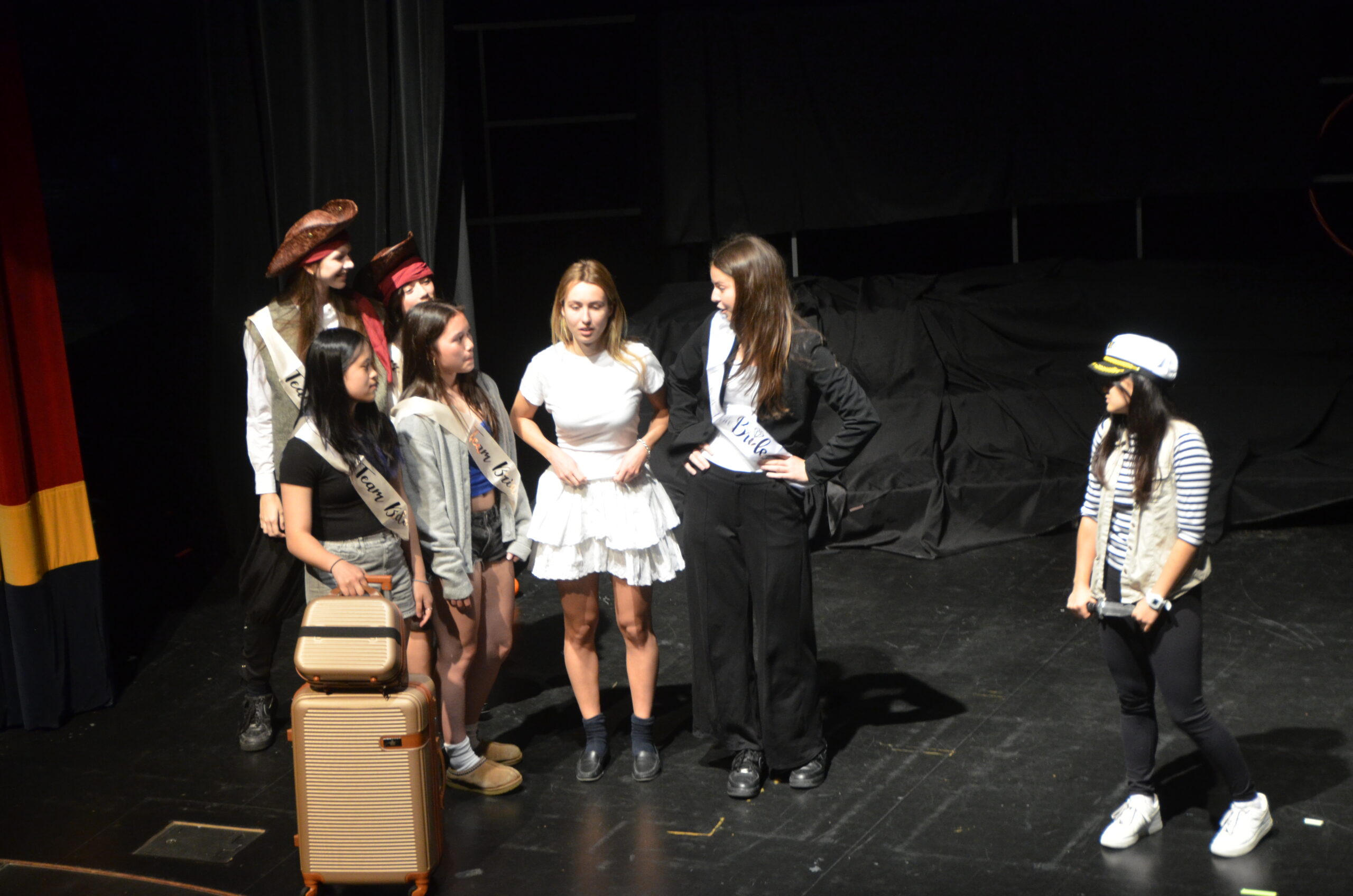
Late last month, a strange scene unfolded in Powell Hall: A young bride-to-be had a heart-to-heart with her mom, despite both of them being tied up by pirates who were facing off against a knife-wielding boat captain and two very soulful dancers.
This surreal vision was a segment from Society, a collective creation produced in Christina McCourt’s Grade 12 Drama class. A time-honoured tradition in Canadian theatre, collective creations are exactly what they sound like—plays in which all members, regardless of their role, contribute to the writing process, and all ideas are considered equally until the text is finalized. If you’ve ever seen improvisational jazz, you have a sense of what coming up with a collective creation is like. Only, instead of a smattering of musicians making suggestions, picture twenty-three of them.
In a typical project, the class would have had parameters to guide them. But with Society, Christina gave them carte blanche, save for one caveat: the final runtime had to be under twenty minutes, as they would also be performing the show in Stratford for the CIS Ontario Drama Festival, before an audience of students from other independent schools and a panel of industry adjudicators.
Torn between drama and comedy as the genre of choice, the class decided to do both and created a pack of subtly interconnected vignettes. In one, a corporate retreat goes awry. In another, a bachelorette party goes similarly. In the final segment, a cult enforces its own secrecy. The students split into groups according to genre and began the collaborative writing phase. For Avery Harris ’27, this brainstorming period was both the joy and the core challenge of the project. “Everyone had their own ideas, and we had to figure out a way to combine their interests while making sure everyone was comfortable with the idea,” she explains.
Ideas flew in from all sides as these dramaturgical musicians adapted their melodies—in this case, story beats and dialogue—to allow for unexpected variations. Sometimes, a note would emerge that appeared dissonant at first. Gunda Stein ’27, who played the aforementioned boat captain in the comedy segment, had wanted to be part of a horror-themed play. But instead of dismissing this notion as incongruous and discarding it entirely, the group agreed she could perform her role as though the captain was from a horror story, musing about screams in the ocean and constantly toying with sharp objects. In the end, the anomaly of this character made the segment even more absurdly comedic, and instead of coming across as discordant, this unanticipated turn became additive, finding its place in the theatrical harmony.
To the uninitiated, collective creation might seem like chaos built on compromise. But in reality, the process teaches students to reconcile and synthesize seemingly disparate ideas and viewpoints, to practice empathy in real time, and to experience inclusion firsthand. In doing so, they learn to balance two of SCS’s major values: creativity and respect.
For Avery, it’s this respectfulness that truly defines collective creation. “Everyone was super gracious of each other’s ideas and shared them equally,” she recalls. “And because of that, every one of us has some part of the play that we know was our idea and that we’re proud of.” In this composition, there’s room for all.